Feb 11 2009

DAY 4: 2 TIMOTHY 2:1-6

Mike Kurtz

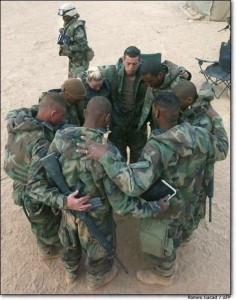
A SOLDIER

Read 2 Timothy 2:3-4.

In the passage today and for the next few days, Paul likens the Christian life to that of a soldier, an athlete, and a farmer. Today, we examine the life of a soldier. Paul says three things about the good soldier:

1) Good soldiers suffer hardship with others (v. 3);

When it comes to suffering, the idea Paul is stressing here to Timothy is that he is not to be afraid to suffer. The Greek form of this command emphasizes suffering together with others. He is literally saying, “Join the ranks of those who bear suffering” (Goodspeed’s translation). Indeed, we are all fellow soldiers in the army of God whose mission is the furtherance of the kingdom of God on earth. Waging war is not without wounds and battle scars. The need for camaraderie on the battle field is critical to the success and perseverance of each soldier. When it comes to fulfilling your mission as God’s soldier, who is at your side? Who is there to pick you up when you fall? And who are you picking up when they fall?

2) Good soldiers are focused in their efforts (i.e. they are highly disciplined) (v. 4a);

Among the hardships of a soldier is the continual difficulty of choosing the right priorities from a long list of potential selections. Paul has in mind here the picture of single-mindedness. The goal is always set before him; his choices are made to fulfill the mission; he avoids those things that would only hinder or distract from the fulfillment of the mission. Now, there are things that are good in life – things that are permissible by all means. But then there are things that are better in life that help one progress further toward Christ. Perhaps the most difficult thing for us as soldiers of Christ is not letting the distractions of the world replace our real mission on earth. How we spend our time and expend our energies says much about the real mission in our lives. Let’s be honest about one thing: the entanglement of the world is unavoidable when we let the world seep into our lives unregulated and unfiltered. Life has a way of entangling us when we just let it go. It takes a conscious effort to stay focused on God’s mission.

3) Good soldiers are committed to carrying out the desires of their commanding officer (v. 4b).

When it comes to choosing from all of life’s choices, it is this one characteristic that helps a soldier determine his or her priorities. Doing what pleases God is the defining criteria for decision making. It is, without coincidence, what keeps one from getting entangled in the affairs of everyday life. If we ask ourselves what is most pleasing to the Lord, that will help us at the very least narrow down our choices.

Two characteristics stand out here (and it will be seen again in tomorrow’s passage) – hard work and discipline.

Now I don’t know about you, but I consider myself a fairly hard worker. The funny thing is, though, the reason I have to work so hard is because I am so undisciplined! We really need to have both. Some people are both very disciplined and very hard workers. I would say that most people are not both (I could be wrong, however.). Your mission this week as God’s soldier is to consider where you are weakest and then do something about it. If you struggle working hard, get someone working with you to push you along. If you are undisciplined, set a very specifc time in your schedule to carry out the important matters of life. If you are in a Home Group, this is an opportunity to let others help you. Look for advice and accountability. We are soldiers – let’s not forget that while the victory is won, the battle rages on until the Lord’s triumphant return.

Print This Post Print This Post

Feb 11 2009

DAY 3: 2 TIMOTHY 2:1-6

Mike Kurtz

PASS IT ON

Read 2 Timothy 2:2.

Yesterday, we saw Paul’s appeal to Timothy to keep being empowered or strengthened by the grace of God. Persevering and remaining loyal to the faith was his appeal. Now he commands Timothy to pass on the treasures of Paul’s teachings to others in order to perpetuate the gospel to succeeding generations. The faith could not be left in the hands of disloyal, half-hearted deserters, but to those who were faithful and able.

Paul’s concern at this time was two-fold: 1) make sure those whom he had entrusted to carry the torch would remain faithful; and 2) those in future generations would also have the good news of Christ accurately and readily available to them. Paul wanted to ensure that his teachings would not be lost or diluted or changed over time. His first concern was met in Timothy. But who would Timothy entrust these truths to? Paul described the future torch bearers as faithful. The word “faithful” here means trustworthy or reliable (NIV), those who could be trusted to remain steadfast in the truth – those who could learn it, understand it, and live it out consistently. Paul also described them as able to teach. As one commentator has noted, they had to be “able and competent… to pass on to others this treasure by their ability and willingness to teach.”[1] Some believe Paul may have been referring to the office of elders as addressed in 1 Timothy 3. Whatever the case may be, we can never have enough faithful and able instructors of the faith to pass down truth. Whether it be in the form of formal instruction or informal influence, the ultimate aim of our interactions with others is to learn from one another and teach others.

To consider: Who passed or is passing the torch to you? (Your parents? A friend?) Who are you continuing to learn God’s truths from? Who are you teaching? Would you consider yourself one of God’s torch bearers: “faithful” and “able to teach”?


[1] Hiebert, Second Timothy, 53.

Print This Post Print This Post
Feb 10 2009

DAY 2: 2 TIMOTHY 2:1-6

Mike Kurtz

OUR SOURCE OF STRENGTH

Read 2 Timothy 2:1-2.

“Be strong!” — preceding this imperative, Paul commanded Timothy to remain true to sound teaching, guarding what had been entrusted to him (1:13-14). Paul then shared about two former comrades who deserted him and one faithful brother, Onesiphorus, who remained loyal. Paul says, “therefore… be strong”, that is, be like their brother Onesiphorus – be strong and show loyalty by passing on to other faithful ones what had been entrusted to him.

The command here is to “be strong” and it means literally “to be strengthened in” (from the Grk. en – in, and dunamoo – to strengthen). The form of the command indicates this is to be an ongoing, moment by moment, day after day strengthening. What is it that he was to be strengthened in? It was “the grace that is in Christ Jesus.” So, while God’s grace brings salvation, it also provides the strength that enables one to live a life in Christ.

All of this begs the question: how is one strengthened by this grace? There are many ways people seek to be strengthened. They may seek it in books and the knowledge of men. They may seek to be strengthened through exercise or recreation. They may seek to be strengthened through relationships. These are all good things, but to be strengthened in the grace that is in Christ, that is something supernatural. Grace by definition is something God gives to us undeservedly. We do not earn it. We do not merit it. We do not deserve it. God simply gives us strength as we come to Him and rely on Him for the strength of daily living. This strength, then, is something we seek from God who is the fountain of grace.

To consider: Remaining loyal to the faith (as Onesiphorus) and to one’s calling (as Timothy) requires daily strength that can only come from God. How do you personally gain strength from God? Do you find it in prayer? Do find it in His word? Are you encouraged by fellow brothers and sisters in Christ daily (cf. Heb. 3:13)? How can you better fulfill Paul’s command to “be strong!”?

Print This Post Print This Post
Feb 9 2009

DAY 1: 2 TIMOTHY 2:1-6

Mike Kurtz

PICTURE PERFECT

In the passage this week, Craig shared how Paul used pictures or illustrations to get his point across. He begins by giving the attitude of a servant of God — to be strong in the grace of God or in other words, be gracious; excel in grace; focus on grace. Even if TImothy should fall short in other areas, be strong in this area. Learn to deal with others favorably even if they don’t deserve it.

This is followed by the activity of a servant — to reproduce the faith. Timothy was given the responsibility to entrust all that he had learned to faithful men. To this end, Craig shared that we should have two kinds of relationships in our lives: one that gives/teaches someone, and one that learns from someone. Reproducing the faith of others is everyone’s responsibility. Personal relationships are one of the best ways to learn and grow.

The illustrations of this attitude and activity are found in vv. 3-6. Paul compares the life of a servant of God to 1) a soldier, who is willing to endure hardship and throw off the things that entangle or prevent him carrying out his commitment; 2) an athlete, who doesn’t take short cuts to grow, but trains hard; and 3) a farmer, who also works hard, and finds great satisfaction in the end. Indeed, the hard work, discipline, and commitment to growing in the grace of God and helping others do the same is satisfying and rewarding.

How do you see yourself in this life of grace? Are you a soldier battling the temptations and distractions of this world? Maybe an athlete who is training to live by the directions God has given in His word to run this race of faith? Or perhaps a farmer striving to work to grow a crop that will eventually produce a harvest of satisfying results in the end? A life of faith requires commitment, hard work, and discipline. I pray God will help you finish well just as Paul did. Blessings on you this week as you spend time with God. –Mike

Print This Post Print This Post
Feb 7 2009

DAY 6: 2 TIMOTHY 1:15-18

Mike Kurtz

REVIEW

Looking back over the week, is there anything that God may be especially impressing upon you? Pray and consider how God might have you respond.

Print This Post Print This Post