REVELATION 1:11-17
Read Revelation 1:11-17.
And now the seven churches are identified in v. 11. As Craig noted a few weeks ago, these were churches in Asia Minor that are mentioned in a seemingly intentional clockwise order in relation to their relative geographical location. (See below) It is almost as if the letters could be delivered in a walk along this order. If nothing else, it is interesting…
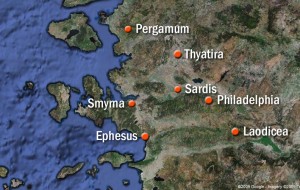 It is to these churches that this revelation is to be delivered. As noted earlier, these churches likely represent more than only the churches of that day, but also the Church throughout history and into the future. This is supported by the statements in the coming chapters, “He who has an ear, let him hear what the Spirit says to the churches.” (2:7, 11, 17, 29; 3:6, 13, 22)
And now after announcing in a loud voice the command to write down and deliver the revelation, John’s vision begins. And it is confusing.
The Vision
In the vision, John sees seven golden lampstands identified as the seven churches (1:20). They are apparently surrounding “one like a son of man” who is clearly the resurrected, glorified Jesus Christ. His description is awesome. His appearance unlike anything earthly, and yet must be described in earthly terms. His voice – like the sound of many waters. Try to imagine a discernable voice with the sound of many waters. Out of His mouth a two-edged sword, no doubt a reference to His word of truth (Eph. 6:17) living and active, able to judge the hearts of man (Heb. 4:12).
The picture of Christ surrounded by the churches – one can imagine looking at the map above with Christ centered and surrounded by the churches, a sort of beacon among the churches.
In His right hand, Jesus holds seven stars, identified as the angels of the seven churches (1:20; now that’s helpful, isn’t it). Who are these angels? While there are several possible interpretations, perhaps the best answer is that these represent the leader(s) of each of the churches. Why earthly beings? Two reasons: (1) the Greek word translated “angel” is literally the word “messenger” (although we have to be careful here because everywhere else in the book of Revelation the word “angel/messenger” refers to heavenly beings); and (2) the letters are written to the angels of the churches (cf. 2:1, 8, et. al) not to the churches themselves. This revelation was to be delivered to an angel of each church, which seems to best fit the elder(s) of the churches who bring the message to their respective congregations. It would be unusual (in fact, unprecedented) for John to deliver the letter to literal angels.
So what we see up to this point is perhaps Jesus being the central focus and beacon of the seven churches, and Him delivering a revelation (through John) to the leaders of the churches. The symbolism in the passage underscores Christ’s unparalleled magnificence and holiness, the importance and significance of the revelation, and perhaps the power and authority of the church leaders (note they are said to be held in God’s right hand – symbolic of God’s power – Luke 22:69).
I don’t know about you, but I was already looking forward to studying the actual revelation. Now I am really looking forward to it!
 Print This Post