Jun
17
2009
Mike Kurtz
Read Revelation 3:15-16.
It was noted yesterday that there didn’t seem to be a hint of misconduct on the part of the Laodicean church early on, but reviewing Col. 4:15-17, it is possible that even at that early date the church needed words of admonishment. Note in Col. 4:17 that Archippus was told to “take heed of the ministry of the Lord,” and that there was another letter (now lost) that was personally written to the church (Col. 4:15). So it is possible the church was slowly becoming lukewarm even 30 years prior to this letter of Revelation. Indeed, a heart does not become lukewarm overnight.
The church at Laodicea was criticized for being neither hot nor cold. There are two popular interpretations for this. The first is one that says the church was stuck in the middle between being fervent in their faith and being completely fallen in their faith. On the one hand a fervent faith would be light and salt in a city that lived in darkness. Their reputation would have been similar to the Thessalonians where “in every place [their] faith toward God has gone forth.” (1 Thes. 1:8) On the other hand their faith could have been virtually non-existent. There would be no question that they did not represent Christ. As is it was, they lived in the middle, giving mixed messages to the world. Jesus says to them in essence, “Either represent Me well, or don’t represent me at all!” Their lukewarmness only left a bad taste in the mouths of those looking on.
Another popular interpretation has to do with the idea that through the city ran an aqueduct which brought water from the hot springs at nearby Hierapolis. By the time the water reached the city, it had become lukewarm, and because it was so high in mineral content, it tasted terrible and was useless in this condition. Had it remained hot, there would have been a useful, relaxing quality to it (imagine relaxing in a hot, mineral spring). Had it become cold, there would have been a refreshing quality to it. As it was, it was neither hot nor cold, and hence, useless. Similarly, the Laodiceans had perhaps become useless to the kingdom in their apathetic condition.
Either way, the church had lost its passion for Christ and consequently, its ability to impact those around them. Clearly, this is a call for self-examination. Do I have a lukewarm faith? What does my life communicate to others? Who is Christ according to my life? These are strong words from Christ. No words of encouragement here, simply a hard pronouncement of guilt. Take some time to reflect upon your life. If you are struggling with lukewarmness, what are some things you can begin doing to bring back some vibrancy to your faith? (May I suggest prayer – go to God with your apathy and ask Him to bring about a change.)
 Print This Post
1 comment | posted in Daily Devotion
Jun
16
2009
Mike Kurtz
As we begin a new week, begin by reading the entire message to the church at Laodicea: Revelation 3:14-22.
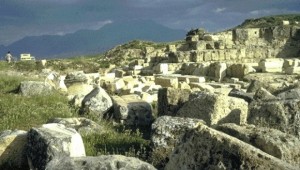 The church at Laodicea was founded in the early years of Christianity and was well established by the time this revelation to the church was given. Laodicea is mentioned five times in Paul’s letter to the Colossians. At the very least, there was a house church in the city meeting at the house of Nympha (Col. 4:15). Judging from this revelatory message to the church at Laodicea, the problems in the church must have developed gradually as there does not seem to be many hints as to their fallen condition in any of the other biblical references.
The city itself was wealthy with a profitable business in the production of wool cloth. So wealthy was the church that when an earthquake destroyed the city in AD 60, they were able to rebuild the city without any outside help. It is thought that the church was lulled to sleep spiritually due to its economic sufficiency.[1]
A first read-through of this letter reveals an utter displeasure by Christ at the condition of the church. There is nothing commendable about it. And it is here that Jesus addresses Himself as “the Amen” – literally, the “so be it.” Many prayers end with Amen. The point here is that when Christ speaks, it is the final word. One had better listen to Him. He then calls Himself the faithful and true witness. While this could be interpreted as a note of encouragement, this is more likely of a back handed insult. Unlike Christ, the Laodiceans appeared to be anything but faithful and true. And finally Jesus refers to Himself as the ruler of God’s creation (lit. the beginning of the creation). All things come from Him. Make a note of that because this was a church that learned to depend on its own strength as we will see.
Amen, faithful and true, before all creation – there is a sense of finality and power in these words. These stand as a precursor to some strong words to come. Consider these as words to us as well. Jesus Christ ultimately has the final word in our lives, and He is faithful and true to carry out His wishes. As the One who is sovereign over all creation, we would do well to heed His words, wouldn’t you agree?
[1] Walvoord, John F.,
The Revelation of Jesus Christ, p. 89.
Print This Post
no comments | posted in Daily Devotion
Jun
8
2009
Mike Kurtz
This week we look at Jesus’ message to the sixth of seven churches, the church at Philadelphia. Since I will be preparing to give this Sunday’s message, I will be taking a break from the devotionals this week. In place of that, I am encouraging YOU to give your devotional thoughts on this passage this week. And here’s how you can do it. You can either:
1) Add a comment to this post (just click “add comment” below this post and follow the directions);
2) Email me a comment, and I just might post it as a devotional!
This is your opportunity to contribute. It doesn’t have to be a lot, just something the Lord impressed upon you. And maybe you’ll have a lot to share — there is no limit. God works through everyone uniquely, and I trust He will shine light on His word in a unique way for you. Share it with us!
This Week’s Passage: Revelation 3:7-13
Print This Post
no comments | posted in Daily Devotion
Jun
5
2009
Mike Kurtz
Read Revelation 2:24-29.
What are things you hold on to? Whether it is a pencil or fork or a teaching or belief, we hold on to the things that are important and essential for us at the time. What are things you don’t hold on to? These are things that are useless or unneeded or harmful to us at the moment. Have you ever tried taking a hot bowl out of the microwave with bare hands? If so, you know it isn’t something you hold on to for very long because it is unsafe and frankly unbearable. Such was the instruction of Jesus to the faithful in the church at Thyatira. These few faithful ones were commended for not holding to the teachings of Jezebel, called the deep things or secrets of Satan (v. 24).[1] Holding to such teachings and practices was unsafe and useless. The faithful were careful not to put their hands into the fire. To these Jesus told to hold on to the truths they had kept until now. They were charged to keep the faith, deeds, love, and perseverance that were the virtues of the church.
It is not merely what one holds on to that makes one strong, but also what one doesn’t hold on to.
For those who hold on to the good and right things and avoid those things that are unsafe and useless, Jesus promises a place in His future kingdom of leadership and care for others. He will rule over nations, and the nations will have no power over them just as clay vessels have no power or authority over their potter. In addition, Jesus promises them the “morning star” – perhaps a reference to Christ Himself (cf. Rev. 22:16).
How about you? What are the things that you are holding on to? What are the things that would take a crowbar to get you to let go? Are they good and right things (e.g. truth, love, patience, a forgiving spirit, etc.) or are they like poison to your health (e.g. bitterness, anger, pride, lust, etc.)? What would God have you continue to hold on to and what would He have you let go of?
[1] The deep secrets of Satan (NAS) may be a reference to the false idea that in order to defeat Satan, one had to enter into the experience of sin and thus be better equipped to serve Christ. Only through experience could one understand the real nature of sin.
Print This Post
1 comment | posted in Daily Devotion
Jun
4
2009
Mike Kurtz
Read Revelation 2:21-23.
God is patient. He gives people time to come to their senses and return to a life with Him. The Prodigal Son comes to mind. Does His patience have limits? Is God infinitely patient? Sounds good, doesn’t it? But is it true? Will God wait patiently for us forever?
Let me suggest that while God’s patience is infinite in its potential (1 Tim. 1:16), it is limited in its outworking. God’s patience is limited by our finiteness. We do not have an infinite amount of time to turn back to God. One day our time will run out and God’s patience will be useless to us. Let me also suggest God’s patience is guided by His love. Because God loves us, He will not strive with us forever while we infect others with our sin. Consequently, God often takes initiatives to bring us back before we run out of time and before we hurt more people. Such was the case with this Jezebel. God gave this person plenty of time to repent, but she refused. The discipline she would receive would be severe, and those she had infected would be purged as well. The bleeding had to stop. And while they were given plenty of opportunities to turn, it is clear they did not want to turn. Their time was running out.
God is patient, and the danger of taking His patience for granted can cause one to think that continued sin in a specific area is not really that bad. Because we don’t experience the consequences of sin, we can think God doesn’t really see it (practically speaking). But here Jesus says that He, indeed, “searches the minds and hearts” (v. 23). Hence, it is important that one not allow that kind of attitude to take root lest one day, when God’s patience has reached our limits, He may take severe disciplinary action. While this paints a picture of a harsh God, in reality, it is because of God’s love that this action is sometimes necessary.
But what of those who are experiencing hardship now? Is God disciplining them for some unrepentant sin? Maybe, maybe not. One must examine his or her life. Have I become apathetic toward a sin? Have I put off repentance for another day (and another and another)? On the other hand, if one is striving to walk with God, and there is a desire to make changes, one can see these times of hardship as God’s way of sharpening and growing one’s faith.
God is patient. He is the most patient person in all of heaven and earth. How is His patience seen in your life? Are there any areas that you need to turn over and turn back to God?
Print This Post
no comments | posted in Daily Devotion